First published 22 Feb 2026. Revised 26 Mar 2026.
The quotations on my home page are overtly political, incisive statements made by people I admire. They reflect my views after a lifetime of immersion in the myth and propaganda of the United States. I understand now that capitalism, socialism, economics, nationalism, war, peace, authoritarianism, climate, racism—all these things—are intimately intertwined; they cannot be neatly separated and must be understood together. If we use one banner for all of them, politics is probably the best.
Words are important because they endure—consider that quotation from George Washington’s farewell address to the nation which he composed 230 years ago in 1796. Words are also the labels we assign to ideas reflecting how we’re thinking about our lives and the problems we’re facing. This short essay emerges from my need to refine, expand, but certainly explain, three of these overly simple labels, specifically capitalism, nationalism, and authoritarianism. Context is important, so links to original sources are provided.
On capitalism
In response to an audience member’s enthusiastic appreciation, Ursula K. Le Guin replied:
Well, I love you too, darling. Books, you know, they’re – they’re not just commodities. The profit motive often is in conflict with the aims of art. We live in capitalism. Its power seems inescapable. So did the divine right of kings. Any human power can be resisted and changed by human beings. Resistance and change often begin in art, and very often in our art: the art of words. – Ursula K. Le Guin, Distinguished Contribution to American Letters Award Acceptance, 19 Nov 2014.
Imagine spontaneously coming up with a response like that—the art of words. Like this gem . . .
The anguish we suffer together is not a mysterious syndrome without physical roots. It’s not a vibe or a mood. It’s an expression of physics supercharged by a uniquely sociopathic form of commerce. – Tim Winton, The Guardian, 20 Sep 2024.
The italicized phrase resonates deeply—it’s meme quality—repeats itself over and over in my head. These, much more pedantic, sentences expand on Tim’s thoughts . . .
By capitalism we do not mean markets, trade and entrepreneurship, which have been around for thousands of years before the rise of capitalism. By capitalism we mean something very odd and very specific: an economic system that boils down to a dictatorship run by the tiny minority who control capital – the big banks, the major corporations and the 1% who own the majority of investible assets. – Jason Hickel and Yanis Varoufakis, The Guardian, 12 Feb 2026.
The conflation of capitalism with “free markets” is one of the most successful lies in human history. The historical and ongoing plunder of resources; the police, armies and death squads deployed against those who resist; the shifting of profits from less powerful nations to the major powers; the intimidation of labour; the conning of consumers; the extraction of rent; the dumping of costs on the living planet: all this is the opposite of “free”. It’s highly coercive and extremely expensive. – George Monbiot, The Guardian, 19 Mar 2026.
These words are super important because they refine and clarify that what I loathe is the “very odd and very specific” (Tim’s “uniquely sociopathic”) system of capital which we live in. It leads, inexorably, to financial and social inequality. So to be perfectly clear, I’m not against “markets, trade and entrepreneurship”. Quite the opposite. However, the so-called “free”, unregulated, quasi-mystical “invisible hand” market as a forum for trade and entrepreneurship has a serious problem. It reduces everything, including people, to a single number, price. Life is just not that simple.
In fact, regulated markets, trade and entrepreneurship exist and thrive in broadly socialist economies, as exemplified by the Scandinavian countries. And yet, so many people believe they have to defend capitalism (mainstream Democrats, for example) or risk being labeled socialists or, even worse, communists. The labels are the problem because they’re way too simple and don’t reflect how real people feel. Maybe some people who call themselves capitalists are actually closet socialists due to this labeling problem? Conversely, perhaps some avowed socialists (far fewer in number) actually might embrace regulated markets, trade and entrepreneurship but don’t want to be associated with the capitalist catastrophe?
Again, labels are the problem, not people. Regular people, for the most part, just want social stability and fairness to prevail. Some semblance of social equality. But that is a concept despised by a minority who actually believe that some people are better than others; those who embrace class distinctions; often those who are privileged; and, quite often, those who hold deeply racist views. Personally, I want none of that.
[I]f intelligence means the capacity to perceive, adapt, and sustain life, then the market is not intelligent—it’s psychotic.
Markets are profoundly unintelligent. They lack goal orientation—there is no aim beyond accumulation. They lack semantic feedback—prices don’t tell us whether we are destroying our biosphere or exploiting our species. They lack error correction—because collapse, in the market’s logic, is not failure but “creative destruction.” And they lack coherence between parts—each actor pursues self-interest, not systemic health . . . Economists often claim that prices “encode” knowledge, but this is a misuse of the word. Data without meaning is not knowledge, and reaction without reflection is not intelligence. The price system is a language with one word—money—and one grammar—more or less. It’s no wonder it cannot speak truth about complex realities. – Peter Joseph, The Myth of Market Intelligence, 10 Nov 2025.
If our lives are utterly commodified and reduced to prices, what have we become? Are we nothing more than “human resources”?
It is easier to imagine an end to the world than an end to capitalism. – attributed to both Fredric Jameson and Slavoj Žižek
Why? Is our social conditioning (or it is brainwashing?) really so strong that it overcomes our capacity to even imagine a better world? Or can we imagine it, yet fear of change paralyzes us from acting to explore alternatives? And if we are not even aware that alternatives exist, what does that say?
On nationalism
Nationalism of one kind or another was the cause of most of the genocide of the twentieth century. Flags are bits of colored cloth that governments use first to shrink-wrap people’s brains and then as ceremonial shrouds to bury the dead. – Arundhati Roy, from an essay called “Not Again” written, not coincidentally, on 11 Sep 2002. Link to full text here.
When I first heard the “flags” sentence uttered, by Arundhati Roy herself, probably on an Alternative Radio broadcast, I was driving and had to pull over because of the emotional impact. Over 20 years ago, that event was literally a turning point in my life.
I don’t have a lot to say about nationalism, except that I detest it. If one thing is crystal clear from a lifetime of scientific thinking, it is that our world is an astonishing, fragile, beautiful, utterly interconnected unity—a web, a mycelium, coral reefs, ant colonies, the internet—metaphors abound. The borders of nation states are not visible from space, they are political phantasms that continue to haunt us. They are not real. They are artifacts of our arrogance and fear. In distinction to this, cultural affiliations rooted in ancient history, language and geography are very real and worthy of great respect and preservation. Our DNA contains about 3 billion base pairs, 99.9% of which are identical when comparing any two random human beings. Biologically, we are one species. Culturally, we are a brilliant mosaic. These facts speak for themselves.
On authoritarianism
The alternate domination of one faction over another, sharpened by the spirit of revenge, natural to party dissension, which in different ages and countries has perpetrated the most horrid enormities, is itself a frightful despotism. But this leads at length to a more formal and permanent despotism. The disorders and miseries, which result, gradually incline the minds of men to seek security and repose in the absolute power of an individual; and sooner or later the chief of some prevailing faction, more able or more fortunate than his competitors, turns this disposition to the purposes of his own elevation, on the ruins of Public Liberty. – George Washington, Farewell Address to the People of the United States, 1796
In this moment of history, this is where we’re at — dealing with the specter of the “absolute power of an individual”. I blame all the politicians who yielded unwarranted power to this petty tyrant, Republicans and Democrats alike. I do not blame people who voted for him – they were conned, twice. The opposing candidates were little better. Our choice was between overtly fascist authoritarianism or thinly veiled corporate (market) authoritarianism. Now we have both. In my view, no one should be proud to be a member of either party because they have both betrayed our country. Become independent. Assert your own mind.
Are we at risk of an authoritarian takeover? SI SI. Open your eyes . . .
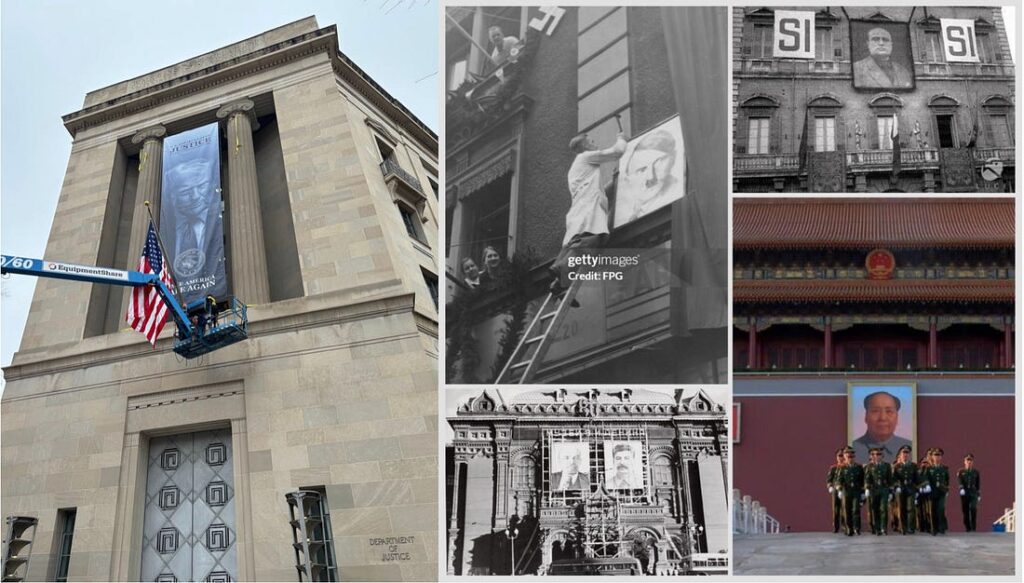
When Power Puts Its Face on the Wall. The portrait is the warning. It always has been.
